
Standing on a slight eminence at what appears to be the geographical centre of the Wirral, Brimstage Hall is a strange and mysterious place.
There is no record of why, when or for whom it was built…
Almost certainly the original house was a compact, fortified, building of the pele tower type, standing at the centre of a fortified area some sixty acres, the whole being enclosed within a moat and high embankment.
Expert opinions concerning the date of the original building range from 1175 to 1350. The first recorded occupants were Sir Hugh Hulse and his wife Marjory, who were granted a licence to build a chapel on 11th February 1398, but there seems to be little doubt that the structure had been in existence for some time before that.
Tradition holds that the chapel was established in the vaulted chamber that stands at the base of the tower. The eminent architectural historians Pevsner and Hubbard have doubts about this, pointing out in their book ‘The Buildings of England – Cheshire’ that the only possible evidence to support it is the existence of a boss in the ceiling which is decorated with three carved fishes, the fish being an ancient symbol of Christianity, but a more likely explanation is that the carving depicts the arms of the Troutbeck Family who occupied the house from a time in the fifteen century. It was Brimstage Hall that in 1459 Sir William Troutbeck rode out to fight for the Lancastrian cause, and, in the event, to die for it at the Battle of Blore Heath in Shropshire.
A ring in another ceiling boss is suspended directly over the spot where the old house well lies beneath the floor. Rediscovered by a group from Cambridge University in 1957, the well was found to contain a quantity of human bones.
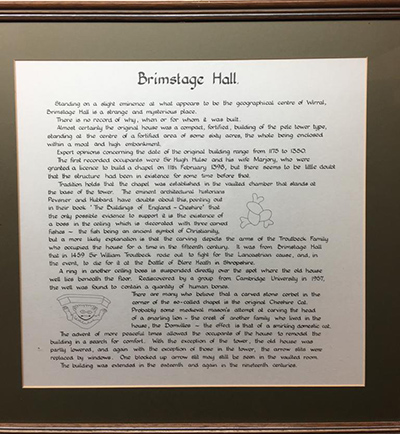
There are many who believe that the carved stone corbel in the corner of the so-called chapel is the original Cheshire Cat. Probably some medieval mason’s attempt at carving the head of a snarling lion, the crest of another family who lived in the house, the Domvilles, the effect is that of a smirking domestic cat.
The advent of more peaceful times allowed the occupants of the house to remodel the building in a search for comfort. With the exception of the tower, the old house was partly lowered, and again with the exception of those in the tower, the arrow slits were replaced by windows. One blocked up arrow slit may still be seen in the vaulted room. The building was extended in the sixteenth and again the nineteenth centuries.
Our Spaces